3 Ways Market Data-as-a-Service Can Protect Your Business
Yesterday’s Infrastructure is Today’s Financial Loss
Skyrocketing message rates and frequent exchange changes push traditional market data systems to their limits. Market data-as-a-Service offers an alternative approach. Outsourcing infrastructure management reduces operational risk and improves resilience, freeing firms from the burden of constant market adaptation. It also allows teams to focus more on trading strategies and innovation, rather than maintaining and scaling infrastructure.
Many firms are turning to this model not just as a primary solution, but as a way to strengthen redundancy, improve flexibility, and better handle periods of market stress.
1. Handle Burst with Redundancy
The data tells a clear story: market data volumes are not just growing. They’re becoming more volatile and less predictable. As shown in the chart below, both message and packet rates have trended upward over time, with sharp spikes in peak message rates reaching as high as 35.7 million messages per second in early 2025. These aren’t edge cases anymore; they’re becoming part of normal market behavior.
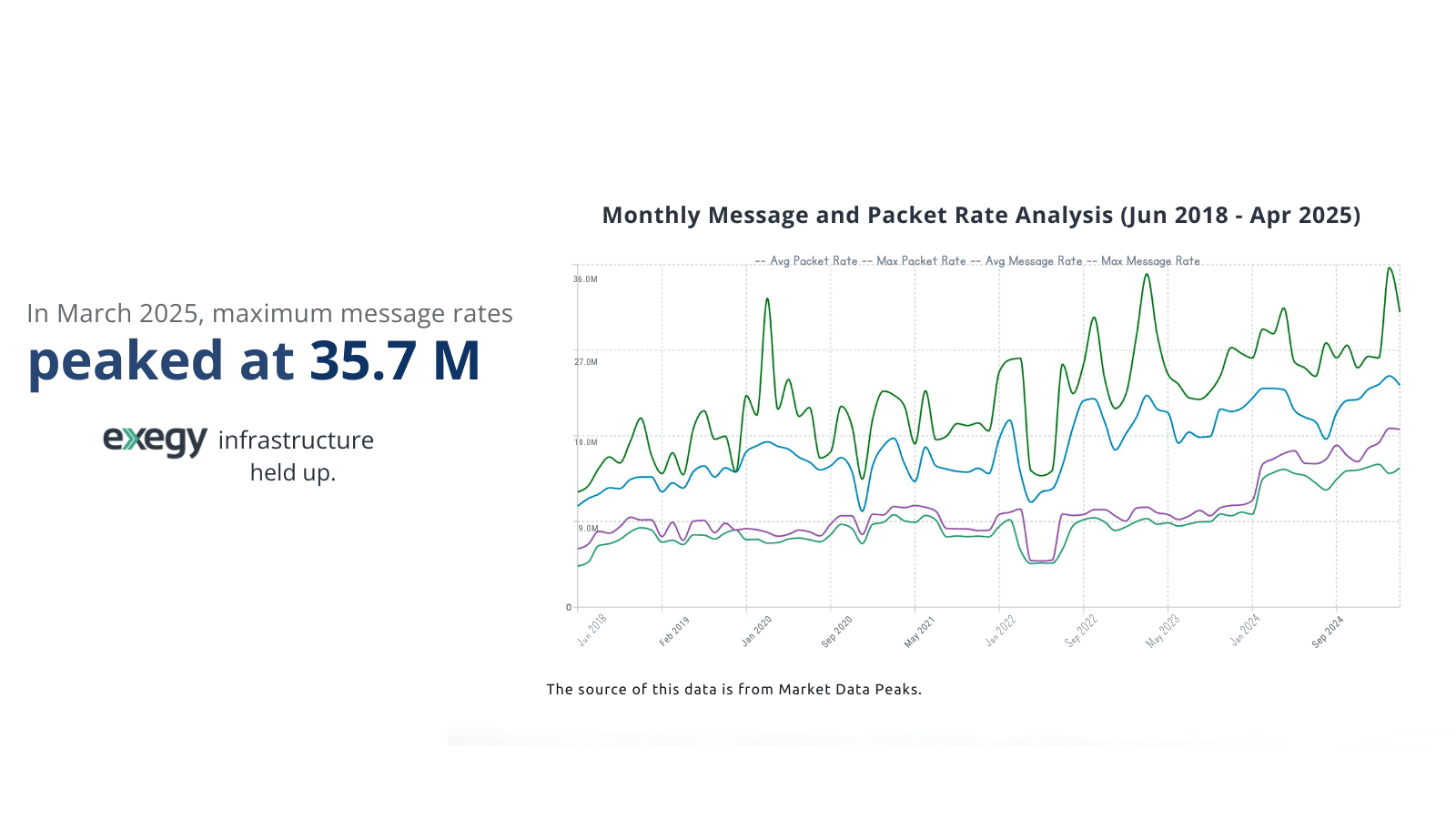
For firms managing their own infrastructure, this creates a constant balancing act. You either overbuild for peak capacity—driving up costs—or risk falling behind during periods of stress, when data loss, latency, or system degradation can directly impact trading outcomes.
Market data-as-a-service shifts that burden. Instead of sizing infrastructure for worst-case scenarios, firms gain access to environments designed to absorb sustained growth and sudden surges in activity. Pooled and continuously managed capacity equips these platforms to handle spikes without sacrificing data completeness or performance.
Just as importantly, this model reduces operational risk. By relying on externally managed infrastructure with built-in redundancy and scalability, firms are less exposed to single points of failure and can avoid the internal resource strain that comes with maintaining and upgrading high-performance data systems.
In an environment where peak volumes are rising, and volatility is compressing reaction times, resilience is no longer just about uptime—it’s about keeping pace with the market itself.
2. Manage Service Teams Save Maintenance Costs
Market data infrastructure requires constant maintenance—bug fixes, upgrades, and adaptation to exchange-driven changes. As the pace of change accelerates, this ongoing work becomes a significant operational burden for internal teams.
At the same time, the financial services industry is highly specialized, making it difficult and expensive to hire and retain the engineering talent required to build and maintain these systems. Managing real-time market data infrastructure often demands expertise across low-latency software, FPGA development, testing, and ongoing system optimization.
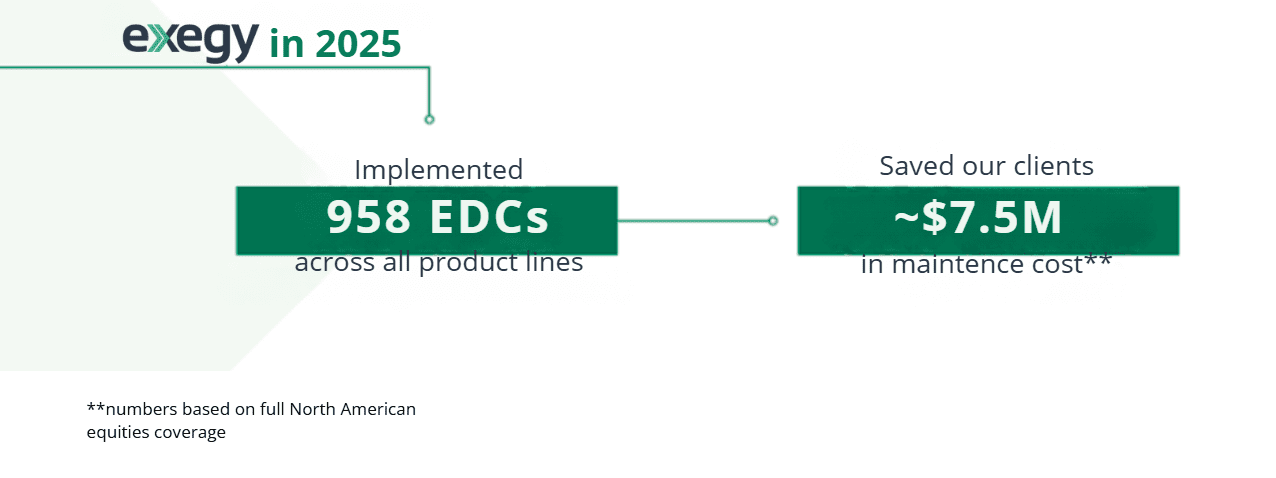
Recent analysis shows that maintaining in-house market data infrastructure can exceed $3.5 million annually, while also consuming thousands of hours of engineering time that could otherwise be spent on trading strategy development and innovation.
By shifting this responsibility to a managed services model, firms can reduce operational overhead, control costs more predictably, and free up internal resources to focus on performance and competitive differentiation.
3. Data-as-a-Service Let’s You Do More with Less
Market data-as-a-service lowers your total cost of ownership and hardware requirements. Take, for example, the changes to OPRA over the last few years.
OPRA expanded its multicast data distribution from 48 to 96 lines, fundamentally changing how options data is distributed. This shift increased peak ingestion requirements and forced firms to re-evaluate their ability to handle burst traffic, not just overall volume.
And the next major change is already on the horizon. OPRA’s upcoming dynamic symbol rebalancing will introduce more frequent and dynamic routing of data across lines, requiring firms to continuously track and adapt to changing distribution patterns.
Exegy’s market data-as-a-service offering, Axiom, uses the same underlying FPGA technology as our more latency-sensitive options. This tech allows Axiom to deliver data consistently, even during volatility spikes and ever-increasing volumes. The end result is firms spending less time and effort trying to solve issues by having infrastructure that just works.
For firms looking to reduce their exposure to risk and protect their trading strategies with reliable, consistent, enterprise-class market data managed by industry experts, Axiom is the ideal solution.
Originally posted on Trader’s Magazine as a part of Exegy’s Trading Reimagined series.