nxFeed
FPGA-based Market Data Processing
nxFeed is a feed handler which streamlines market data application development by processing data feeds on FPGA and making them available to applications via a simple, normalized API.
Download BrochureWhat is nxFeed ?
nxFeed is a feed handler which streamlines market data application development by processing data feeds on FPGA and making them available to applications via a simple, normalized API.
Designed to complement trading applications or in-house ticker plant development, nxFeed will arbitrate, decode, normalize and build order books on a plug-n-play, FPGA-based NIC — significantly reducing application processing resources and overall latency. This allows developers to focus on what they do best – build core business logic.
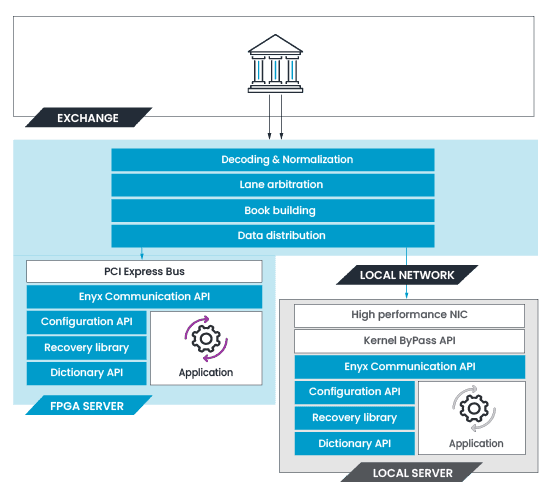
nxFeed reduces market data processing latency and server footprint compared to software-based solutions while also providing the flexibility for deployment as an in-application architecture using PCIe or distributed via UDP multicast over Ethernet.
Who should use nxFeed?
Frequently used by electronic trading applications or normalized data processing systems — nxFeed has the flexibility and power to process raw market data from even the most volatile exchange feeds.
Designed to be a tool in any market data developers toolbox nxFeed is easy to integrate with new or existing applications. nxFeed provides data processing with plug-and-play, FPGA-enabled market data handling and a simple C++ API.
When used for algorithmic trading, integrating nxFeed is often a first step towards end-to-end FPGA-based trading strategies using nxAccess, the Enyx execution engine with an embedded FPGA algorithm sandbox and accelerated execution capabilities.
How is nxFeed unique?
With constant, deterministic, and jitter-free performance, nxFeed filters unnecessary data and increases overall performance by reducing the network and server load. Whether publishing updates to a local application via PCIe or over the network to remote applications — nxFeed guarantees consistent and transparent performance.
With software simulators available to aid the development cycle — the path to integrating with the nxFeed API is simple and can be achieved in as little as a week. There is no requirement to install dedicated FPGA hardware, allowing firms to maximize time-to-production for their applications.
With an easy-to-use API, nxFeed offers features that were typically reserved only for software solutions:
- TCP-based remote application resynchronization
- Centralized dictionary management
- Centralized application administration & management
- Live monitoring counter & latency statistics
By taking advantage of the portability of FPGA-based NIC, nxFeed can be deployed alongside your application on the same server, or as a feed handler serving data to many remote applications.
nxFeed is designed to easily scale from single server to multi-site trading infrastructures by including two types of access via a single API:
- PCIe local delivery for an application running on the host server
- UDP Multicast over Ethernet distribution for up to 8 different normalized feeds
Performance Reports
Average
<1.2 µs*
Maximum
<8 µs*
*SOP-to-SOP latency measured on the switch
Supported Markets






nxFeed: Use cases
- Internal data distribution without having to normalize and build books for each exchange format
- Single, simple, normalized API delivered to existing software application stacks
- Delivery of market data updates over PCIe to application via C++ API
- Lowest latency configuration
- Initial step towards nxAccess — an FPGA-based trading engine
- Leverage nxFeed to normalize data and distribute only what is required over network locations
- Simple, consistent client API for receipt of data
Specifications
- Average Latency < 1.2 μs
- Maximum Latency < 8 μs
- Between 16-250k symbols per card (See: Global Market Coverage)
- By-Message A/B feed arbitration
- Book-based & order-based normalized market data
- Symbols / message type / book depth filtering
- Exchange resynchronization
- Normalized protocol across venues
- Comprehensive APIs for configuration & symbology management
- Up to 8 UDP multi-cast outputs with different publication configurations
- TCP-based consumer resynchronization
- Live monitoring counter & latency statistics
Related Resources

New PCAP Service from Exegy Offers FPGA-grade, Hardware-timestamped Raw Market Data Capture
New York, Chicago, London — October 13th, 2026 — Exegy, the provider of high-performance market data and trading infrastructure for capital markets firms, is today announcing in partnership with FMADIO,…
Migrating Market Data to a Cloud Environment
Migrating market data to the cloud can assist with development, compliance, and strategy backtesting. Whatever your use case, Exegy can help.
Exegy Secures Double Victory at WatersTechnology IMD & IRD Awards for Market Data Excellence
Recognized as Low-Latency Provider of the Year while ExegyNexus™ earns Best Real-Time Market Data Initiative. New York, St. Louis – September 25, 2026 – Exegy, a leading provider of market data, trading technology, and…