24/5 Trading: The Infrastructure Shift Behind 24-Hour Markets
Just a few years ago, financial institutions faced the question of whether there would be sufficient demand for 24/5 trading. Today, however, the question has evolved into how the industry will define and support this new norm.
A recent roundtable discussion, moderated by Exegy Chief Technology Officer Arnaud Derasse, featured three expert panelists:
- Jason Wallach, Chief Executive Officer of Bruce Markets. Bruce Markets is an overnight ATS designed to provide seamless digital investor experiences and bring greater reliability to extended-hours trading.
- John Willock, Chief Revenue Officer of Blue Ocean Technologies. Blue Ocean is a unique capital markets fintech company empowering global investors by making trading possible during US overnight trading hours.
- Elliot Banks, Chief Product Officer of BMLL. As a data expert at the table, BMLL represents the leading independent provider of harmonized Level 3, 2, and 1 historical data and analytics across global equities, ETFs, global futures, and US equity options.
In the webinar, the group examines what’s happening across 24-hour markets today, including rising participation, evolving liquidity patterns, and the operational realities firms are facing as trading activity expands beyond the core session.
What Is the Current State of 24-Hour Stock Trading?
The panel spent time discussing today’s market while also looking ahead to how the competitive landscape could evolve as exchanges expand trading hours. Today, when the industry refers to “continuous trading,” it generally means a 23/5 model, with a daily pause for reconciliation, maintenance, corporate actions, and other operational processes. What we are currently seeing is the evolution from near-continuous 23/5 trading toward true 24/7 markets. As it stands, overnight trading is no longer experimental, and it is quickly becoming part of the norm.
The Practical Reality of 24-Hour Markets
Institutional interest has moved from curiosity to implementation. What does this upward trajectory look like? The group discussed how firms are now actively requesting overnight venue data, analyzing liquidity patterns, and incorporating overnight markets into trading decisions—not just watching from the sidelines.
Average daily notional volumes in the overnight session have grown from a niche retail interest to figures exceeding $1 billion or more in 2026. Wallach of Bruce Markets highlighted the growth of the overnight ecosystem, noting significant year-over-year volume increases across the three ATSs. Bruce Markets itself is backed by major industry participants, including Fidelity Investments and Robinhood.
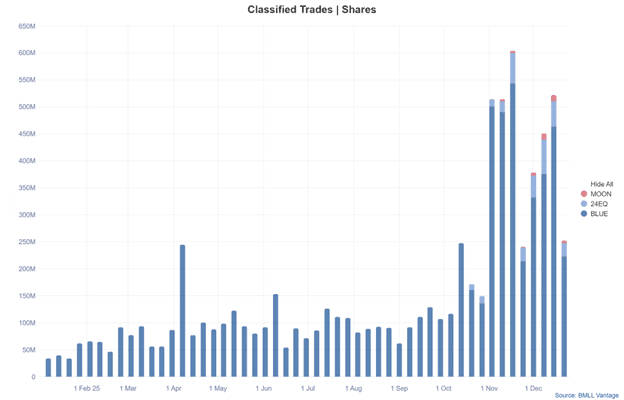
A few years ago, the biggest challenge was proving demand. Now, demand is clear, and the barrier to mass adoption is structural liquidity—specifically, the compounding challenge of market data fragmentation and the absence of a unified pricing reference. Although spreads and depth can be comparable to certain daytime venues, liquidity remains highly concentrated by time and security, and no regulator-mandated consolidated overnight BBO currently exists.
How Do Structure, Standards, and Transparency Enable 24-Hour Markets?
The panel went on to discuss how, while current regulatory frameworks support consistent price discovery during the core session, the growth of 24/5 trading presents new challenges around governance, transparency, and standardization across fragmented venues operating outside the national exchange framework. The challenge is no longer establishing demand, but building the market structure needed to support it.
The fundamental question is this: How does overnight market quality compare to regulated core-session trading when viewed through the lens of fragmentation, spreads, and price dislocations?
Maturation and Regulation of the Market
Wallach and Willock also highlighted a potential point of tension as exchanges move toward 23/5 trading. Overnight venues currently see their highest trading volumes during the first hour of the session, from approximately 8:00 to 9:00 p.m. ET. Under the proposed exchange schedules, however, that same period would fall within the exchanges’ daily maintenance window. Existing overnight ATSs therefore have little incentive to give up their highest-volume hour, suggesting that their role may continue to evolve alongside expanded exchange hours..
The Question of Implementation and Timing
Major exchanges, including Nasdaq and NYSE Arca, are positioning themselves to offer expanded trading hours, potentially changing the competitive landscape significantly. Nasdaq has received regulatory approval for 23/5 trading, while NYSE Arca’s plans remain subject to the applicable rulemaking process. Implementation will also depend on overnight SIP availability, processor readiness, and broader industry coordination. In the meantime, solutions such as Exegy’s Overnight Best Bid and Offer (OBBO) address the lack of consolidated visibility across existing overnight venues while the broader market structure continues to evolve.
In short, there’s no question that 24/5 trading is growing, but a huge part of the challenge is that the definition of “continuous markets” is already evolving. As exchanges move into near-continuous trading, leading ATSs are working to prepare for what comes next.
How Can the Tech Stack Be Future-Proofed?
As overnight volumes continue to grow, competition is accelerating market evolution, though liquidity remains highly concentrated and fragmented. A few years ago, the biggest challenge was proving demand. Now, the demand is clear, and the barrier to mass adoption is structural liquidity—specifically, the compounding challenge of market data fragmentation and the absence of a unified pricing reference. Spreads are wide, volume is hyper-concentrated, and no mandated OBBO exists.
As traditional exchanges prepare to launch expanded trading hours, currently targeted for later this year, overnight ATSs will need to evolve again.
Willock explained that these venues are already looking beyond 23/5 toward true 24/7 trading to differentiate themselves and maintain their competitive advantage. Banks of BMLL shared analytical insights showing strong overnight market activity with tight spreads and clear volume curves, particularly noting the importance of understanding liquidity dynamics between exchanges and ATSs.
How Do We Prepare for the Next Market Evolution?
The discussion made it clear that today’s 23/5 market is unlikely to be the final destination. As exchanges expand trading hours, the next competitive frontier is likely to be true 24/7 trading—making infrastructure readiness more important than ever. The webinar concluded with agreement that 24/7 trading is inevitable, driven by factors including blockchain technology, tokenization, and global market demands.
The industry conversation has shifted from “if” to “how” regarding 24/5 trading, with more evolution to come. Naturally, the market continues to mature, creating opportunities as it expands into a more inclusive ecosystem, one that allows room for growth for all parties.
If you’re planning for continuous markets, download Exegy’s Ultimate Guide to 24/5 Trading, a practical road map for getting ready without adding unnecessary complexity.