Insights from the Capital Markets Innovation Summit | New York 2026
Preparing for Intelligent, Continuous, and Fragmented Markets
On September 10, Exegy hosted the Capital Markets Innovation Summit in New York, where leaders from across the industry discussed how artificial intelligence, extended trading hours, tokenization, and changing market structure are reshaping the requirements for modern trading platforms.
A consistent message emerged throughout the day: the next generation of capital markets will be more intelligent, continuous, and fragmented. Firms will need infrastructure that preserves performance and control as the boundaries between trading sessions, asset classes, and execution venues continue to shift.
Exegy CEO David Taylor opened the Summit with four priorities for meeting that challenge: removing latency as a variable, ensuring availability, conquering fragmentation, and preparing for growth in developing markets.
Keynote: The Future of Market Structure
Phil Mackintosh, Chief Economist at Nasdaq, began with a reminder of why market structure matters. Efficient markets help companies raise capital and give investors access to growth. Electronification helped reduce spreads by approximately 90% while increasing trading activity, but the framework designed to connect the modern US market is now being tested by new forms of liquidity.
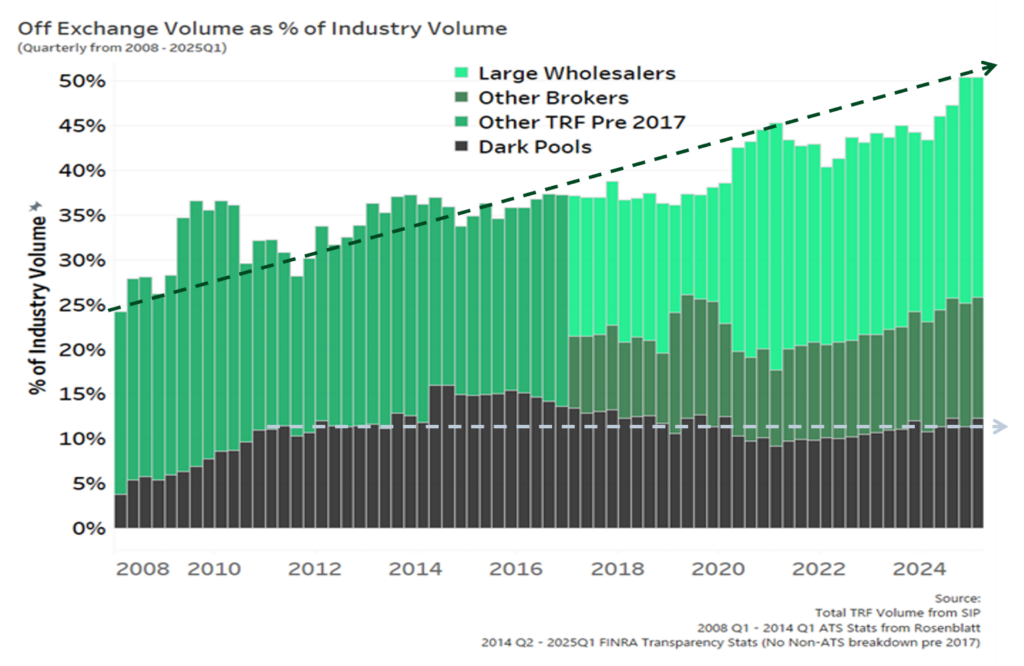
More than half of US equity volume now trades off exchange. Mackintosh emphasized that this does not simply reflect growth in traditional ATS activity. Bilateral trading and segmentation have changed where liquidity sits and who captures the spread, while lit venues now account for only about 30% of continuous trading.
That shift has intensified debate around Rule 611 of Regulation NMS. The Order Protection Rule links displayed quotes across exchanges and supports the National Best Bid and Offer, but it also adds routing complexity and can encourage venue proliferation. Reform could give brokers more flexibility to seek deeper liquidity and better overall executions, although the market would still need a dependable way to measure best execution.
Mackintosh then looked beyond today’s market structure to tokenized stocks, overnight trading, AI agents, and prediction markets. Overnight demand remains concentrated in a relatively small group of US stocks, particularly technology and AI names, and liquidity remains thinner than during core hours. Yet growth from Asian investors and the planned expansion of consolidated tape processing show that global demand for access outside the traditional market day is becoming harder to treat as an edge case.
Executive Panel Market Structure Implications for Next Generation Trading Platforms
The morning executive panel brought together Tony Lee of Alpaca, Noel Reyes of RBC, and Sean Spector of OneChronos to discuss how trading platforms are responding. Three themes dominated the conversation.
Overnight demand is real but uneven. Lee described how overnight venues give international investors a better experience than waiting for the US opening auction. Retail brokers see that demand directly, while many institutions may wait for deeper liquidity before committing significant resources.
Fragmentation can create value when venues solve a real problem. Spector challenged the assumption that fragmentation is inherently harmful. Alternative execution models can reduce market impact or improve the handling of specific orders. The more useful test is whether a venue provides differentiated liquidity and better outcomes, rather than simply adding another endpoint to the market.
AI is becoming a market participant. The panel considered what happens when the end user is an AI agent rather than a person. As agents begin making investment and routing decisions, trading platforms will need to design for machine-driven demand, changing both the user experience and the technology stack beneath it.
Combined, those trends point to a market where firms must connect more sources of liquidity while maintaining a clear view of price, execution quality, and risk.
Capitalizing on the New Market Order
Exegy CTO Arnaud Derasse connected these market shifts to the infrastructure required to support them. Firms are facing pressure from several directions at once: unprecedented options data volumes, rapid growth in overnight equities, increasing demand for new regions and asset classes, and a growing need to understand latency across the full data path.
OPRA demonstrates why average capacity no longer tells the whole story. Burst rates reached 55 million messages per second in May 2026 as thousands of listed instruments and a growing number of exchanges produced nonlinear spikes during volatile periods. Similar patterns are emerging across Asia-Pacific and Middle Eastern markets, where rising baseline activity is punctuated by sudden peaks.
Derasse also highlighted the operational implications of 23/5 trading. Overnight share volume increased 900% year over year, while notional volume grew from $1.5 billion to $8.6 billion. Longer sessions compress maintenance windows, change staffing requirements, and increase the duty cycle of systems originally built around the regular market day.

The takeaway is that supporting more markets cannot mean recreating the same infrastructure burden for every new feed. Firms need a more unified way to add coverage, absorb unpredictable volume, and measure transport, processing, and distribution latency without extensively refactoring existing applications.
Partner Spotlight: From Ultra Low Latency to Enterprise Independence
Terry Roche, co-founder and CEO of marketsIO, shifted the discussion to enterprise market data. Roche examined how bundled commercial models can limit choice when proprietary data, distribution technology, and governance remain tied together.
The alternative is a gradual path toward independence. Firms can separate sourcing, distribution, and governance one decision at a time, beginning with a feed or asset class where the economics are especially compelling. OPRA provides a useful example because its scale makes infrastructure costs and operational demands highly visible.
The objective is not to replace an entire enterprise environment at once. It is to preserve the interfaces applications already use while creating the freedom to make independent sourcing and technology decisions over time.
Keynote: Institutional Real World Assets and Tokenization
Tim Gorham, Founder and CEO of Strands, returned to a theme from the London Summit: the significance of smart contracts lies in the operating model they enable, not only in the assets they tokenize.
Hyperliquid remains one of the clearest examples. Its infrastructure allows participants to launch markets through smart contracts, while perpetual futures linked to real-world assets are growing faster than tokenized spot shares. Robinhood Chain offers another model, allowing other developers to build on its infrastructure while Robinhood retains much of the resulting economics.
Gorham also highlighted the emerging utility of tokenized collateral. Institutions have begun using tokenized funds, equities, and Treasuries in margin workflows, allowing the underlying asset to remain with a custodian while an on-chain representation moves between counterparties. Smart contracts can combine trading, margin, clearing, settlement, and reporting in ways that would otherwise require several systems and repeated reconciliation.
The volumes remain small compared with traditional securities markets, but the economics and pace of development are increasingly difficult to ignore. When connecting to another product becomes a software function rather than a large integration project, new markets can develop much faster.
Executive Panel: Building Institutional Infrastructure for Digital Assets
The afternoon panel with Chris Larkin of E*TRADE, Cromwell Coulson of OTC Markets Group, and Gorham focused on what institutions need before those models can move into the mainstream.
Larkin described a future in which clients move between traditional and on-chain products through a single platform. Building that experience requires enterprise-grade custody, regulatory permissions, and operational controls before demand becomes fully visible. Waiting carries its own risk, particularly as digitally native investors accumulate and inherit more wealth.
Coulson emphasized that traditional and digital infrastructure will ultimately need to converge. Institutional firms bring expectations around governance and protection that digital-native markets did not initially prioritize, while tokenized US stocks could expand access for investors in markets where the underlying shares remain difficult to trade.
The discussion reinforced that institutional adoption will not come from placing a digital wrapper around an existing asset. It will depend on whether firms can integrate digital products into familiar workflows without maintaining disconnected technology stacks.
The Next Era of Low Latency Trading
Laurent de Barry, Exegy Chief Product Officer, brought the day’s market-structure themes back to the trading stack. Data center space and power have become harder constraints, AI workloads are contributing to competition for server components, and extended trading hours have reduced the maintenance windows firms once relied on. Conventional market-data processing can also consume 30% to 50% of the CPU capacity on individual trading servers.
The latency race is still on, but the definition of performance is expanding and now needs to include determinism and resiliency to handle today’s markets. Firms increasingly need deterministic behavior during data bursts, visibility across the latency path, and systems designed for failover. Speed without predictability or control provides a less dependable trading advantage.
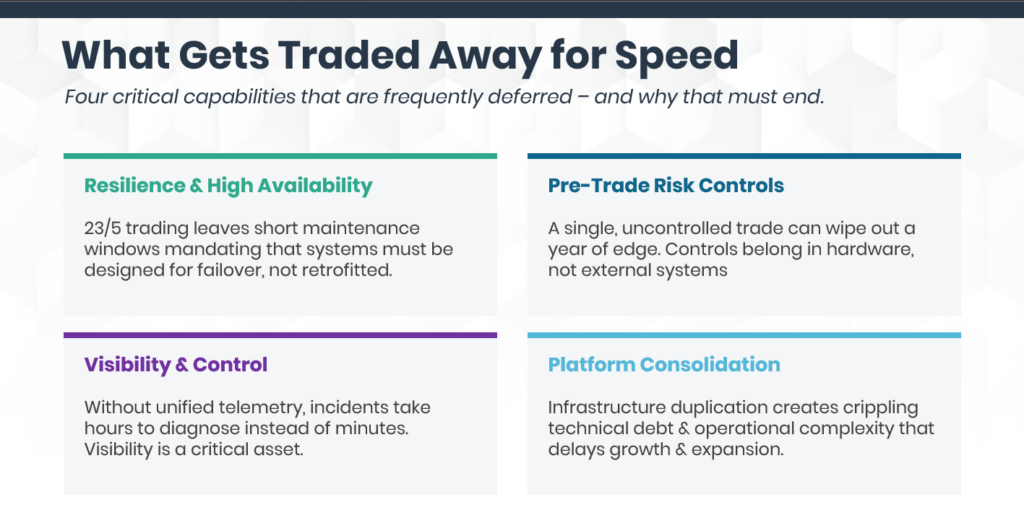
De Barry presented Exegy Nexus as a foundational platform for market-data processing and execution, allowing buy- and sell-side firms to focus on their business while relying on Nexus to provide performance and functionality. By combining centralized feed handling with FPGA processing at the trading edge, the architecture can reduce server requirements while supporting low-latency market data, market making, and smart order routing. Advanced support for wireless execution, cross-strategy communication, centralized monitoring, and embedded risk controls extend the value beyond speed alone.
The final panel with Ritesh Chaudhary of Clear Street and Eric Powers of Citi reinforced that point. Latency has become multidimensional, encompassing jitter, resiliency, and consistency. Newer platforms may benefit from fewer legacy constraints, while established institutions bring deep operational experience and the resources to remain stable during market stress. Long-term advantage will depend on combining agility with that operational discipline.
Looking Ahead
Across the day, four themes consistently resurfaced. AI is evolving from a tool into an active market participant. Low latency increasingly means predictability and control as well as speed. Fragmentation is spreading liquidity across a wider range of market models. Continuous trading is changing the operating model required to support them all.
The common infrastructure challenge is visibility. As markets become more continuous and diverse, firms must be able to understand where liquidity exists, how quickly data and orders move, and whether systems remain resilient under changing conditions.
Thank you to everyone who joined us in New York and contributed to the discussion. We look forward to continuing the conversation as these changes move from emerging trends into the core of capital markets.