Insights from the Capital Markets Innovation Summit | London 2026
Solving Today’s Technology Challenges
On April 15, Exegy hosted the Capital Markets Innovation Summit: London Edition, where industry leaders discussed key trends like market convergence and digital assets, setting the stage for future market infrastructure strategies.
The firms best positioned for the future aren’t just those with the fastest hardware, but those who can modernize their infrastructure without sacrificing resiliency, control, or performance.
Keynote: The Inevitable Rise of Smart Contracts and Automation
The Summit opened with a provocative keynote from Timothy Gorham, Founder and CEO of Strands. While many discussions around digital assets focus on the “what” (tokenization, ETFs), Gorham focused on the “how”: the underlying technology of smart contracts.
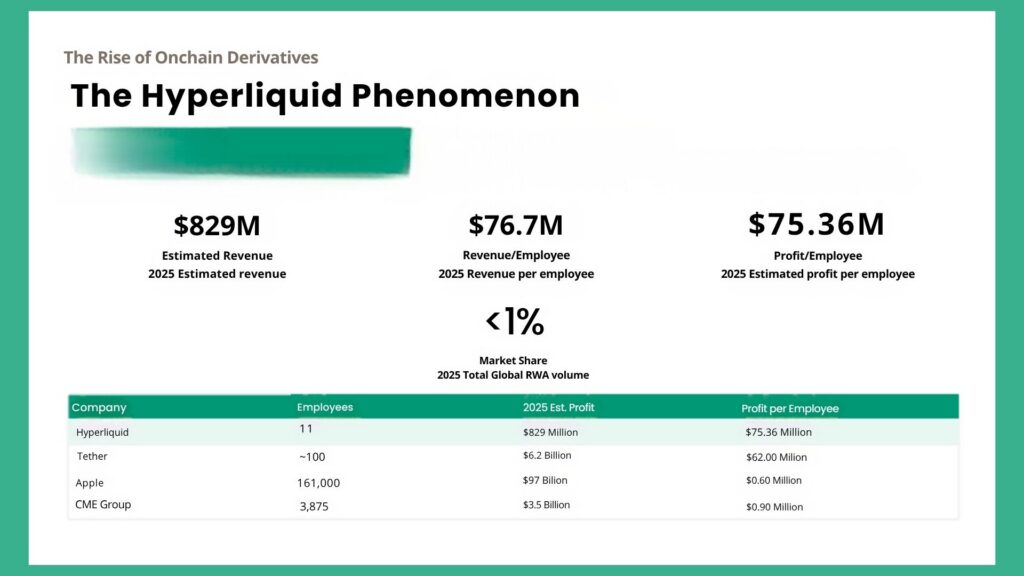
Hyperliquid was one of the clearest examples Gorham used to bring that point to life. Gorham used it to show how automation can reshape a market from the ground up. Hyperliquid operates with just 11 employees while generating extraordinary profit, creating a profit per employee that far exceeds traditional businesses. In Gorham’s framing, that was the real story: smart contracts do not just support new products, they dramatically compress the human and operational burden required to run a market at scale.
The broader implication is that this is not just about crypto-native experimentation. It’s about a new operating model for markets. Distributed infrastructure requires no scheduled maintenance and 100% uptime— operating 24/7/365. For traders, a market that is always available represents immense value, allowing software-based rules and programmable financial logic to unlock entirely different economies of scale.
“The technology doesn’t care. The technology will win eventually.”
–Timothy Gorham, Founder and CEO, Strands.
The takeaway? Software-based rules and automated settlement aren’t just for crypto—they represent a structural efficiency that will eventually redefine all of capital markets.
Executive Panel: Emerging Challenges Are Becoming Core Challenges
Our morning executive panel explored how shifts once considered “edge cases” are now moving to the center of the desk. Three themes dominated the conversation:
- 24/5 is an Infrastructure Issue: Demand for trading U.S. equities and global assets outside traditional hours is no longer hypothetical. The challenge is ensuring front-to-back office systems can handle reduced downtime and continuous operating windows.
- The Convergence of Assets: Firms are no longer asking if digital and traditional assets will coexist, but how. The “frontier” is now dictating the expectations for the “core.”
- Flexibility is the New Scale: You can’t solve today’s volume spikes by just adding more servers. Architecture must be “built for change”, agile enough to adapt to fragmented liquidity and evolving regulation without a performance hit.
The consensus among the panelists was clear: the “wait and see” approach is no longer a viable strategy as the boundaries between traditional finance and frontier technologies continue to blur. Competitive advantage has shifted from those who react to change to those who build for it. The next generation will be defined by their ability to maintain institutional-grade stability while embracing the agility and continuous nature of the digital-first era.
Scaling to Frontier Markets Without Scaling Risk
Arnaud Derasse, Exegy CTO, addressed the operational reality of expanding into frontier markets. In a market environment that demands “everything, everywhere, all at once,” writing software is no longer a differentiator.
Derasse emphasized that speed of delivery and automation are what matter. As trade volumes rise across the Middle East and APAC, firms need infrastructure that is “frontier-ready by design,” allowing them to add market coverage without adding unmanageable risk or overhead.
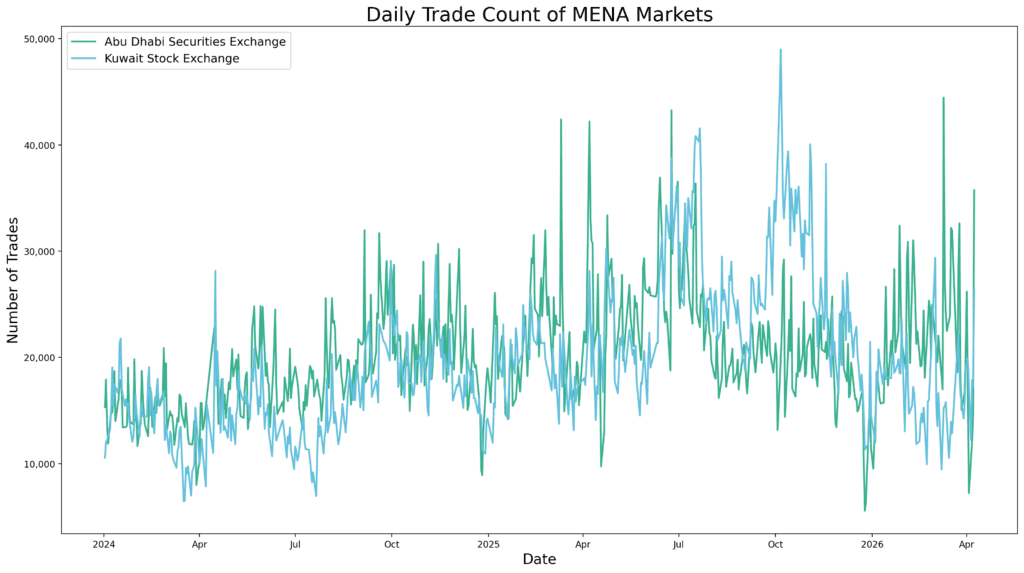
The chart above shows tracking daily activity for select MENA markets.
In it, the data demonstrates not just a general trend of rising trade volumes, but also extreme and unpredictable volatility. Sudden spikes show the operational burden that traditional systems struggle to handle without scaling risk.
The chart quantifies the strain. It highlights that traditional approaches of scaling hardware or layering complex systems can’t keep pace with this level of volatile growth. The core takeaway is that this extreme volatility makes “frontier-ready” infrastructure (which Exegy provides through unified, high-performance tech) a critical requirement, not a luxury. Firms need tech that can absorb these bursts deterministically.
Thought Leaders in Action: Scaling FPGA in the Real World
The fireside chat with Gael Vasseur of Nomura explored how firms can sustainably scale FPGA technology across global markets, emphasizing long-term infrastructure planning over just performance gains.
This session shifted the conversation from why firms want performance to how they make it sustainable. Instead of treating hardware acceleration as a narrow ultra-low-latency tool, the session positioned it as part of a longer-term infrastructure roadmap. That fits with one of the recurring themes of the day that performance, flexibility, and maintainability can no longer live in separate conversations.
Conquering Capacity Strain with Smarter Infrastructure
Laurent de Barry, CPO, and Olivier Cousin, Director of FPGA Solutions, brought the day’s infrastructure themes into even sharper focus. The session covered how firms are modernizing their data stack to unlock performance, flexibility, and scale. The latency race is still on, but pure speed is no longer enough. Firms now need determinism under burst conditions, infrastructure that can evolve quickly, and ways to control mounting cost and complexity.
Several factors compound pressure on trading infrastructure. Data volumes are climbing. Space and power are becoming harder constraints in key data centers. Legacy in-process market data systems impose a heavy CPU tax. And the move toward 23/5 and 24/7 trading is shrinking the maintenance windows firms used to rely on. Firms can no longer solve latency and capacity problems by throwing more servers at them.
To meet these challenges, the team showcased how Exegy Nexus was purpose-built to unify feed handling, normalization, monitoring, and FPGA acceleration into a single stack.
The Takeaway: Offloading API and market-data processing through the Nexus appliance and NIC can materially reduce server footprint and annual operating costs, while still supporting extremely low-latency use cases. If the future is more distributed, more data-heavy, and more continuous, infrastructure has to become more adaptable and more efficient.
EuroCTP and the Challenge of Consolidation
Later in the afternoon, the conversation turned to market structure in Europe through a fireside chat with Eglantine Desautel, CEO of EuroCTP.
In many ways, the EuroCTP discussion reinforced a central theme of the day: market complexity is increasing even in areas where the goal is simplification. The discussion reinforced that whether you are consolidating fragmented data or extending hours, the hurdles are rarely just technical; they sit at the intersection of regulation, governance, and architecture.
Strategy Outlook: Building for the Full Spectrum
Closing the day, Exegy CEO David Taylor tied these themes together into a unified vision for the future. Exegy is expanding its portfolio, covering everything from overnight equities and prediction markets to the Middle East and EuroCTP, but the focus remains on operational transformation.
The goal for 2026 and beyond? Unified infrastructure. Support for ultra-low-latency and enterprise use cases, flexible deployment (on-prem, hosted, or cloud), and the ability to handle both traditional and emerging markets in one place.
Looking Ahead
If last year’s Summit was about rethinking market data, 2026 was about the redefinition of the system itself. Markets are faster, more global, and more automated than ever before.
Thank you to everyone who joined us in London. Your insights continue to drive our roadmap. If you couldn’t make it to London, we hope to see you at the New York City Edition in September.