How Digital Assets Are Changing Trading
Digital assets are no longer a niche market. They have become a proving ground for new market structures, smart contracts, tokenization, and prediction markets. As adoption accelerates, these innovations are beginning to influence how firms think about trading, liquidity, and market infrastructure.
During Exegy’s Markets Without Limits webinar, Exegy CTO Arnaud Derasse and Strands CEO Tim Gorham explored how digital asset technologies are reshaping capital markets. From programmable assets and smart contracts to prediction markets and highly automated trading venues, the discussion highlighted why these technologies are attracting growing attention from institutional firms and what they could mean for the future of market infrastructure.
Digital Asset Inflection Point: What’s Happening Now
During the webinar, Derasse explained that capital markets have continually evolved—from open-outcry trading pits to electronic exchanges. The next evolution is the transition from electronic records to shared, programmable digital ledgers that reduce reconciliation delays and modernize market infrastructure.
Several key trends are driving this evolution:
- Tokenization: Transforming financial assets into programmable digital instruments.
- 24/7 Markets: Enabling continuous global access beyond traditional trading hours.
- Smart Contracts: Automating settlement, compliance, and ownership transfers through code.
By turning a static electronic record into a programmable token, firms can automate workflows, reduce operational friction, improve capital efficiency, and create new models for ownership, settlement, and liquidity.
During the session, Derasse positioned tokenization as the next evolution of electronic markets. That view is increasingly shared across the industry. In his 2025 annual letter, BlackRock CEO Larry Fink wrote that “every stock, every bond, every fund—every asset—can be tokenized,” arguing that tokenization could reduce settlement times from days to seconds while improving market accessibility and capital efficiency.
The technology making this possible is the smart contract. During the webinar, Gorham described smart contracts as the programmable foundation of digital markets—software that automatically executes predefined rules once deployed. Rather than relying on intermediaries to process transactions, smart contracts automate settlement, compliance, ownership transfers, and other operational workflows, creating deterministic outcomes with minimal manual intervention.
The result is faster settlement, 24/7 market access, improved capital efficiency, and the ability to scale operations without a proportional increase in headcount or operational complexity. As Derasse explained, this programmable infrastructure is laying the foundation for a new generation of digital-native trading venues and operating models.
A New Market Model: What On-Chain Infrastructure Makes Possible
One of the webinar’s central themes was that digital assets are not simply creating new asset classes; they are enabling entirely new market models.
Gorham explained that developers built crypto-native markets around automation from the outset. Unlike traditional financial markets, which rely on central intermediaries, discrete settlement cycles, and relationship-driven liquidity, many digital asset venues use smart contracts, specialized blockchains, and programmable infrastructure to automate market operations.
This shift is transforming market structure, particularly the way firms create and manage liquidity.
Early decentralized exchanges relied on Automated Market Makers (AMMs), which use mathematical formulas and liquidity pools instead of traditional order books to facilitate trading. AMMs democratized liquidity creation and enabled anyone to participate as a liquidity provider. However, they can introduce slippage during large trades and limit the sophisticated trading strategies institutions often require.
As institutional participation has grown, many venues have adopted Central Limit Order Books (CLOBs) that more closely resemble traditional exchanges while preserving the benefits of on-chain infrastructure. According to Gorham, this evolution mirrors the progression of traditional finance but has unfolded over just a few years, driven by rapid advances in blockchain scalability and execution technology.
Hyperliquid exemplifies this new approach. Rather than relying solely on an AMM model, it operates a fully on-chain central limit order book built on a purpose-designed Layer 1 blockchain. Its architecture supports approximately 200,000 orders per second with sub-second finality, demonstrating that decentralized markets can deliver performance approaching that of traditional exchanges while maintaining the transparency and programmability of blockchain infrastructure.
The discussion highlighted that these technical advances are not simply about speed. They enable entirely new operating models where automation replaces many manual processes, creating the foundation for the next generation of digital-native trading venues.
Unit Economics Case Study
Hyperliquid illustrates what becomes possible when developers design market infrastructure around automation from the outset. Instead of layering blockchain technology onto traditional market models, Hyperliquid combines a high-performance, fully on-chain exchange with a purpose-built Layer 1 blockchain that supports perpetual futures, dated futures, options, and event contracts on a single infrastructure layer.
During the webinar, Gorham pointed to Hyperliquid’s 2025 performance as evidence of this new operating model. The platform generated approximately $857 million in revenue with a team of just 11 core contributors—equating to roughly $78 million in revenue per employee and making it one of the most productive technology companies in the world by that measure.
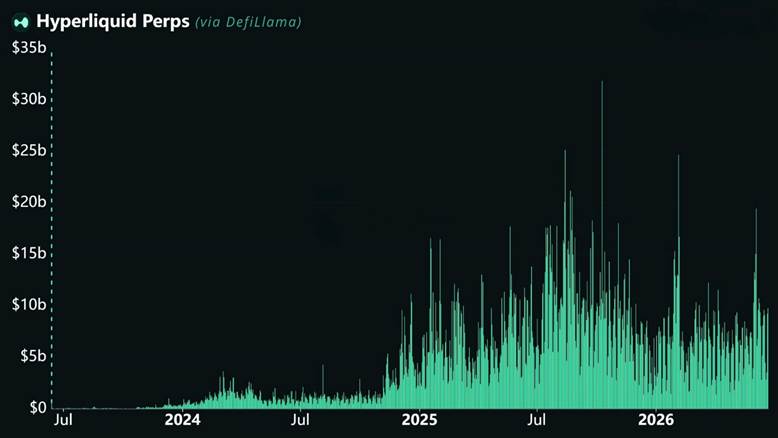
The significance isn’t simply the financial performance—it’s how it was achieved. By embedding automation directly into market infrastructure, software replaces many operational processes that traditionally required large teams. Rather than scaling headcount alongside trading volume, platforms like Hyperliquid scale primarily through technology.
For institutional firms, the takeaway extends well beyond digital assets. As firms support more asset classes, longer trading hours, and increasingly complex market structures, automation offers a path to greater operating leverage. Smart contracts and programmable infrastructure enable organizations to expand capabilities, accelerate product delivery, and reduce operational complexity without a proportional increase in resources.
The Next Frontier: Prediction Markets, Tokenized Equities, and RWAs
The same technologies that power automated trading venues are increasingly being applied to prediction markets, tokenized assets, and AI-driven financial workflows. During the webinar, the speakers discussed how these innovations are expanding the scope of digital markets well beyond cryptocurrencies.
One example is the rapid growth of prediction markets, which are creating new ways to price probabilities and aggregate information. Platforms such as Polymarket and Kalshi are generating new sources of market intelligence and tradable signals through event-based contracts. Institutional interest is growing as well. In March 2026, Intercontinental Exchange (ICE) invested an additional $600 million in Polymarket, valuing the company at approximately $20 billion.
The discussion then turned to real-world assets (RWAs) and tokenization. By representing traditional financial assets as programmable digital tokens, firms can unlock new sources of liquidity, improve collateral efficiency, and broaden market access. Industry estimates suggest the market for tokenized real-world assets could reach $16 trillion to $30 trillion by 2030.
Tokienized Equities
Perhaps the clearest sign that tokenization is moving into the institutional mainstream is the growing involvement of traditional market infrastructure providers. As highlighted during the webinar, DTCC plans to begin limited production trades using its tokenization service in July 2026, with a broader launch expected in October. The service is designed to support tokenized versions of DTC-custodied assets—including eligible Russell 1000 securities—while preserving the same ownership rights and investor protections as traditional securities.
Major exchange operators are moving in the same direction. Nasdaq has received regulatory approval to support trading and settlement of eligible securities in tokenized form, while ICE is developing infrastructure for the trading and on-chain settlement of tokenized securities. Together, these initiatives demonstrate that tokenization is no longer confined to crypto-native markets—it is becoming part of the future roadmap for traditional capital markets.
As markets become more programmable, firms gain access to new asset classes, new sources of alpha, and entirely new market structures. The question is no longer whether digital asset technologies will influence capital markets, but how firms will prepare for and participate in this next generation of financial infrastructure.
How the Exegy + Strands Managed Solution Helps Firms Operationalize Digital Assets
As digital asset markets continue to expand, firms face a growing number of venues, protocols, and data sources. Accessing centralized exchanges (CEXs), decentralized finance (DeFi) protocols, prediction markets, tokenized securities, and on-chain data often requires multiple integrations, specialized technologies, and ongoing infrastructure maintenance. The opportunity is significant, but so is the operational complexity.
During the webinar, Derasse and Gorham emphasized that as tokenization moves further into institutional markets, firms will need more than connectivity—they will need infrastructure capable of supporting traditional and digital assets through a unified operating model.
Rather than building and maintaining individual exchange connections, Web3 integrations, blockchain nodes, and market data pipelines, firms can leverage managed market data services to reduce development effort and operational overhead. This allows engineering teams to focus on trading strategies, analytics, and product innovation instead of maintaining connectivity across an increasingly fragmented ecosystem. Similar themes are emerging across the financial industry as institutions build infrastructure to bridge traditional and digital markets.
Bringing Traditional and Digital Markets Together
The Exegy and Strands partnership combines Exegy’s managed market data infrastructure with Strands’ digital asset expertise and on-chain market intelligence. Together, the firms provide institutional access to centralized exchanges, DeFi protocols, prediction markets, and emerging digital asset venues through a unified delivery model.
The Exegy Axiom feed delivers normalized real-time digital asset and prediction market data alongside global equities, futures, options, and other traditional asset classes. By integrating both centralized and decentralized market data into existing workflows, firms can evaluate and deploy multi-asset strategies without fundamentally changing their market data architecture.
Looking Ahead
The webinar concluded with a practical message: firms do not need to decide today whether every asset will eventually be tokenized. They do, however, need to prepare for a future where traditional and digital market infrastructure increasingly coexist.
As more exchanges, clearing organizations, and financial institutions adopt programmable assets and blockchain-based workflows, organizations that build expertise and modernize their market data infrastructure today will be better positioned to participate in the next generation of capital markets.